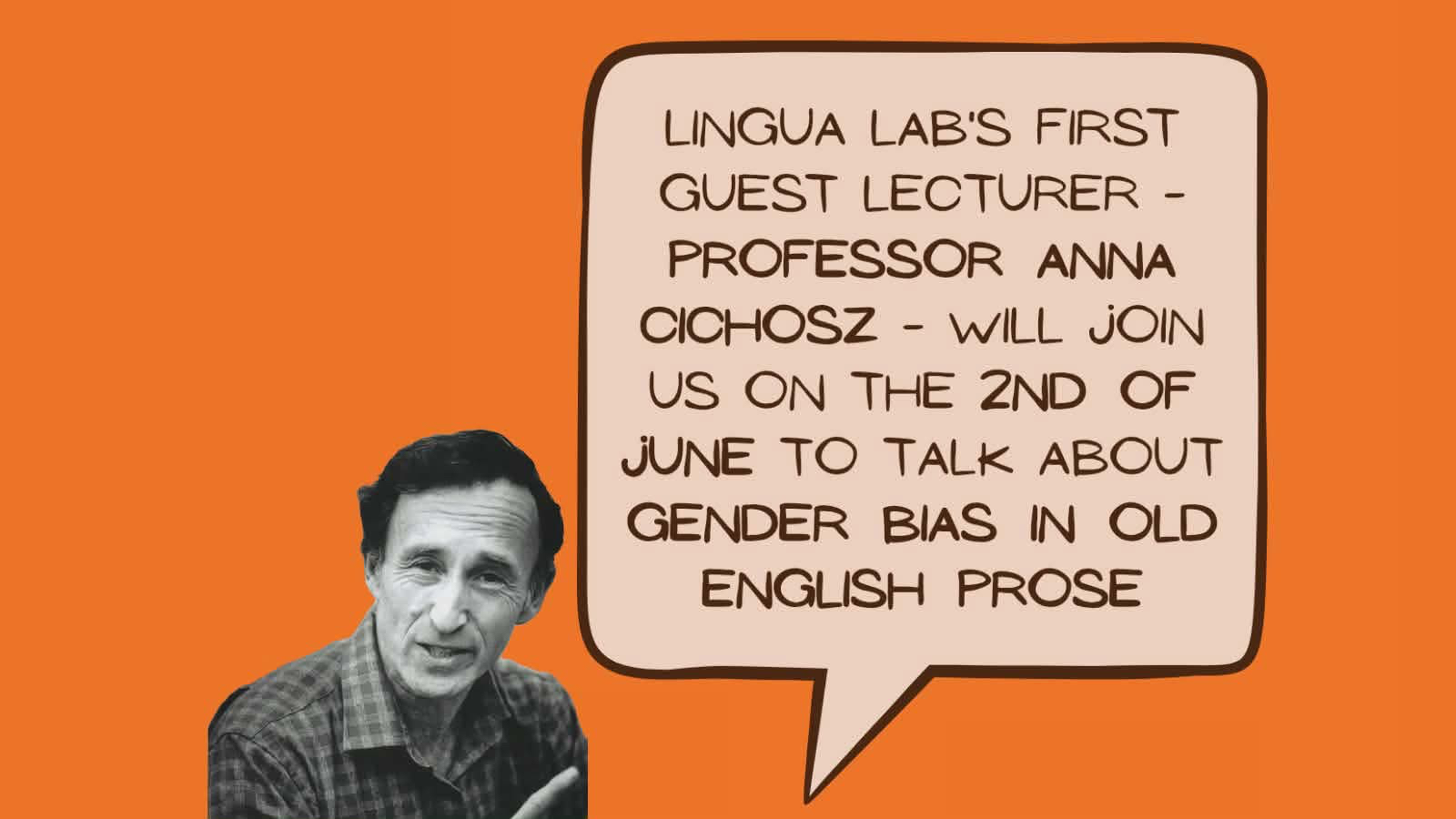
Feminist linguists working on contemporary data have shown how both “the lexicon and grammatical system of English contains features that exclude, insult and trivialise women” (Cameron 1992: 101). In my talk I will show you the origin of the so-called gender bias in English and its manifestations in Old English (OE), when stereotypical representations of gender differences were first formed.
The study is a corpus-based investigation of a number of collocation patterns built around the most frequent OE gendered lexemes attested in the York-Toronto-Helsinki Parsed Corpus of Old English Prose (YCOE), classified into 5 groups:
• general terms – wif ‘woman’, fæmne ‘woman, girl, maiden’ and wifmann ‘woman, female servant’ contrasted with wer ‘man’
• parent – modor ‘mother’ contrasted with fæder ‘father’
• child – mægden ‘girl, maiden’ and dohtor ‘daughter’ contrasted with sunu ‘son’ and cnapa ‘boy, servant’
• sibling – sweostor ‘sister, nun’contrasted with broþor ‘brother, monk’
• person with a higher social position – cwen ‘queen, noblewoman’, hlæfdige ‘lady, noblewoman’, abbodesse ‘abbess’ and nunne ‘nun’ contrasted with cyning ‘king’, hlaford ‘lord’, abbod ‘abbot’ and munuc ‘monk’
The analysis of collocations is based on items extracted from the YCOE corpus by means of the VARIOE online dictionary (Pęzik & Cichosz 2021) and filtered manually after close inspection in context. The results confirm that the way in which women and men are represented in OE is drastically different and reveal that women are significantly more often than men presented in the context of their physicality, family relations and childbearing, while men are frequently portrayed as owners of women, which emphasises their clear superiority in the Anglo-Saxon society.
See you on 2 June at 17:00 in room -34